

OFFA - Stage+
L’« Office de la formation en alternance » (OFFA) est un organisme responsable dupilotage de l’alternance proposée par les opérateurs de l’enseignement (CEFA, IFAPME,SFPME) en Belgique francophone.
Dans ce cadre, l’OFFA désirait mettre à disposition de ces opérateurs et de leurs apprenants un outil permettant de mettre en relation les entreprises agréées cherchantdes stagiaires avec des apprenants en recherche de stage en alternance.
Project description
Challenge
The project's objective was to create a web application enabling all the actors involved in the process (learners and their legal representatives, operators' agents, authorized companies, etc.) to create their account and access the specific functionalities that concern them:
- creating internship positions and managing applications for companies
- search for internship positions and submit applications for learners
- monitoring and reporting for the various agents
- and much more...
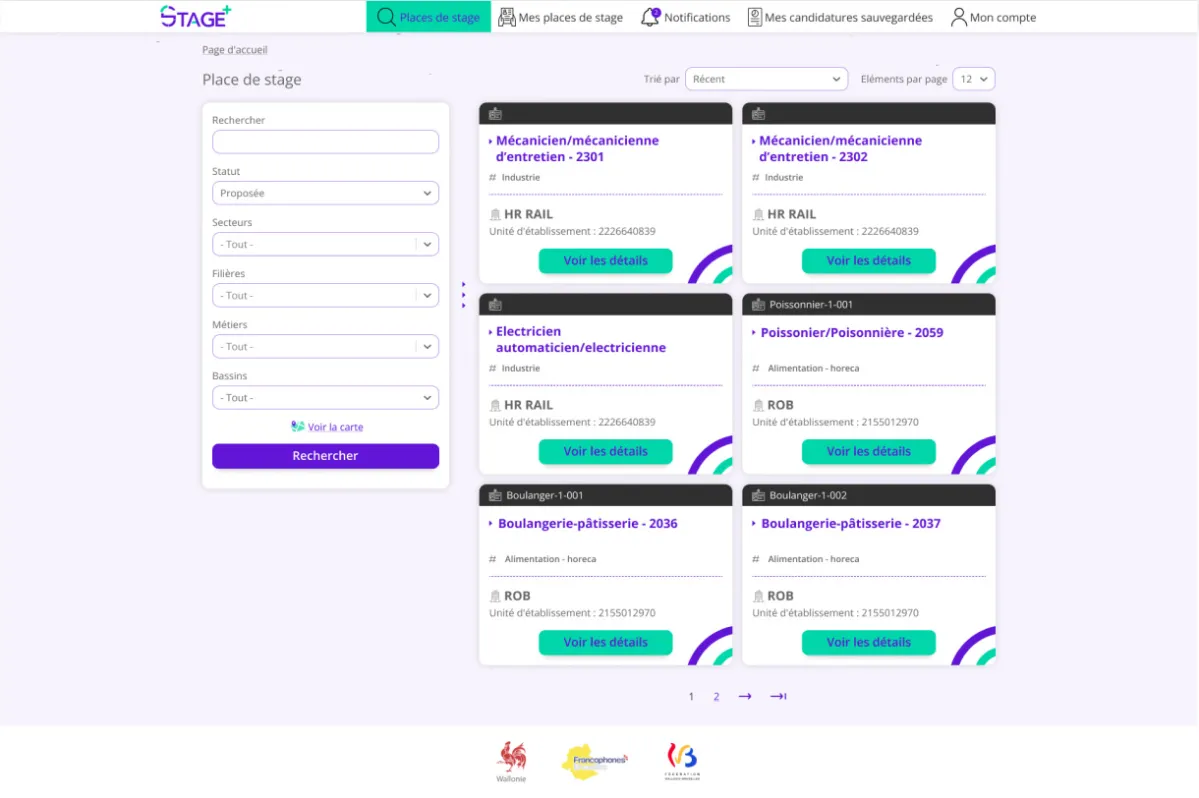
As the plaform was new to the OFFA, there was no existing context to take into account. Nevertheless, the OFFA had done a great deal of work to describe the needs of the various users involved in the matching process between learners and approved companies.
Familiarity with and appropriation of this preparatory work was therefore the first stage in the collaboration between the OFFA and NSI. A cross-functional team was then mobilized to develop the application using our Prince2 Agile methodology, in close collaboration with the OFFA team.
Solution
This web application has been developed with a Drupal 10 backoffice and front-office, and is also available as a PWA.
This web application has been developed in compliance with WCAG 2.1 standards at AA level.
Strong authentication is provided using BOSA's FAS authentication (authentication using an identity card or It's me), and the application is highly integrated with "OPLA", the OFFA's business application for retrieving all data related to companies, authorized companies, sectors, etc.
The application is hosted in “NSI Managed App containers” on an AWS infrastructure, and is covered by a technical and evolutionary maintenance contract with NSI.
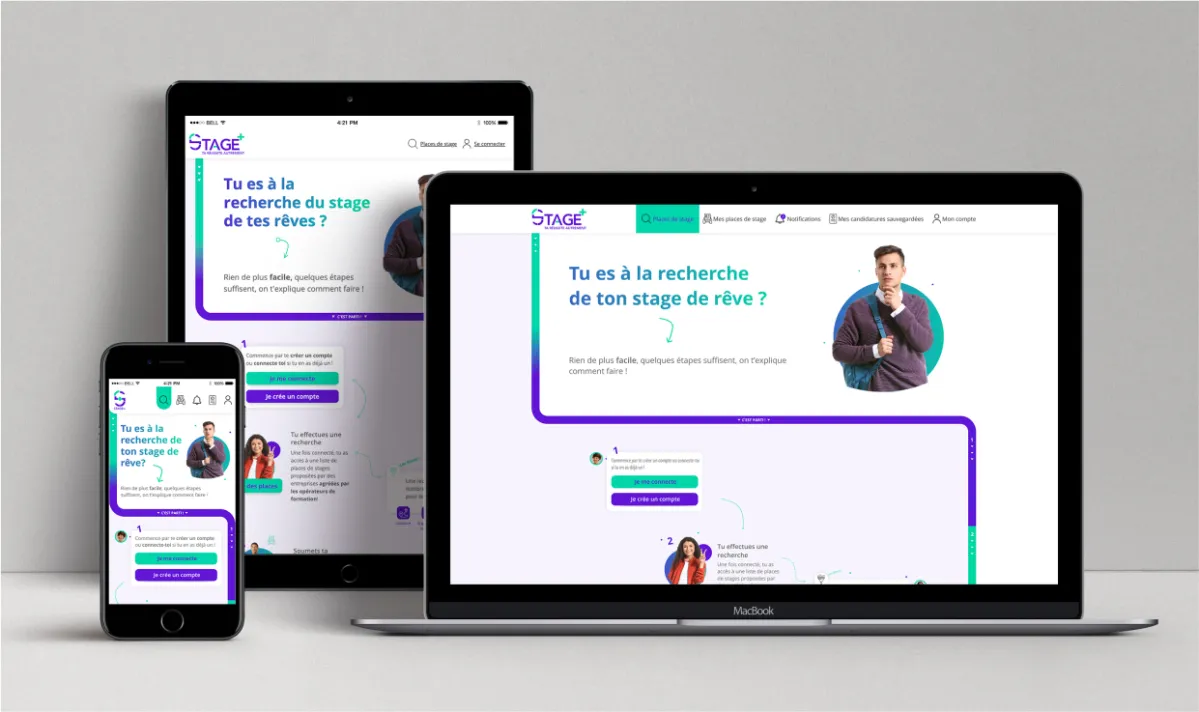
In order to deliver a 'mobile-first' approach, which is essential to facilitate use of the web application by the relatively young target group of learners (who are mainly active on mobile devices), particular attention has been paid to performance:
- Setting up an infrastructure (on AWS) enabling "auto-scaling" to support usage peaks.
- Setting up the application as a PWA to take advantage of the local cache (among other benefits)
- Compliance with website/application development best practices (images in next-gen format and correctly sized, caching, reduction of 3rd-party dependencies, compression of CSS/JS resources, etc.)
- Consideration of eco-design principles (in particular: use of heavy media in a reasoned and responsible manner).
Security was ensured by compliance with our 'Security by design' approach, integrated into our production processes, and by securing the hosting (WAF, security scans of containers, fine-tuned access management, etc.).
For this project, we also designed a graphic identity (based on the OFFA graphic charter) and a logo for the "Stage+" brand.
The interface was designed to facilitate adoption by a relatively young audience ('mobile-first' approach) and to make the user experience as simple as possible, for both learners and company representatives.
Why Drupal was chosen
Drupal was selected as the technical solution because of its flexibility (customized user experience, the possibility of a mobile-first approach, compliance with WCAG 2.1 AA standards), ease of integration with third-party services (OFFA's business application « OPLA », FAS BOSA), low ownership costs (no license costs for Drupal) and guaranteed follow-up of security updates (via our technical maintenance contract).
In addition, the diversity of the roles involved in this project and the sensitivity of access to information being an important aspect of this project, Drupal's functionality for managing highly granular user roles and permissions was a determining factor.